

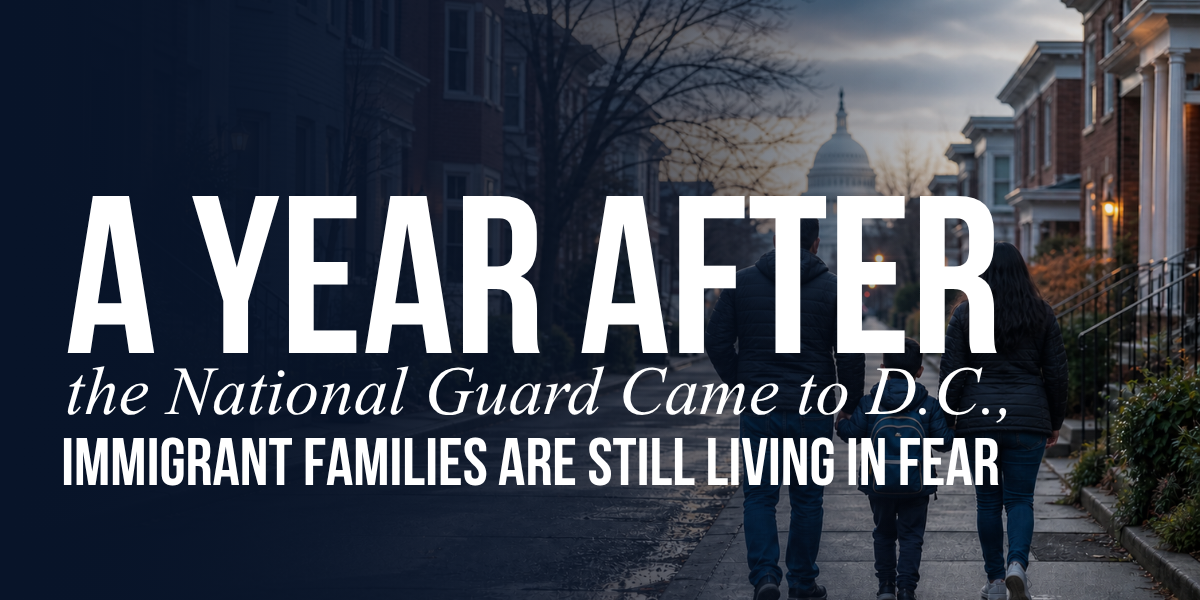
One year ago this week, 800 National Guardsmen began descending upon D.C., and Metropolitan Police Department (MPD) officers began assisting Immigration Customs and Enforcement (ICE) operations. In a city of predominantly Black and Brown residents, August 2025 marked the start of a period defined by fear, uncertainty, and eroded trust.
For the clients we serve at Ayuda, the National Guard deployment brought feelings of uneasiness and discomfort. Meanwhile, the collaboration between MPD and ICE has had devastating consequences for all of us that immigrants continue to bear the brunt of today.
How Section 740 of the Home Rule Act Led to MPD and ICE Collaborating
On August 11, 2025, President Trump invoked Section 740 of the Home Rule Act, allowing deployment of the National Guard in D.C., as well as federal control of MPD. The administration posited that this 30-day period of overreach was needed due to a local “crime emergency,” while D.C. community-members and advocates like alike were quick to decry the farcical pretense.
Ayuda Executive Director Paula Fitzgerald noted at the time, “If the administration is truly concerned about public safety, it would not pursue sweeping militarization nor would it criminalize the residents who call this city home.”
Only days later, MPD’s commanding officer issued EO 25-005, which mandated indefinite cooperation between local police and ICE. Our city’s police forces have worked hand in hand with immigration enforcement ever since.
When Local Policing and Immigration Enforcement Overlap
The immediate impact of the federal takeover was nothing short of devastating for our community. Before August 2025, ICE arrested an average of 71 people per month in D.C. After the National Guard deployment and expanded federal enforcement, that average climbed to 325 arrests per month—more than a fourfold increase. At the same time, the share of people arrested who had no criminal record jumped from 31% to nearly 80% (1,297 of 1,624 arrests after August).
For Ayuda and our immigrant clients, the consequences of MPD and ICE collaborating were much more personal than numbers. We serve individuals and families from all over the world, many of whom are survivors of traumatic crime. They are also the parents, students, neighbors, and workers who make our city great.
The Impact of National Guard, ICE, and MPD on D.C. Immigrants
When this federalization effort began, our clients began isolating at home, fearing that being seen could put them at risk of arrest and deportation. They avoided work for as long as they could afford, even forgoing health and immigration-related appointments that could have devastating consequences if missed. The risk was simply too great.
One of the most harmful and heartbreaking results, however, has been the chilling effect on survivors of sexual assault, domestic violence, and other traumatic crimes. While reporting crime to MPD has never been easy for immigrant survivors, the department’s collaboration with ICE has turned seeking protection and justice into risking family separation.
A Year Later, Fear Still Shapes Everyday Life for D.C. Immigrants
Although the number of immigration arrests in D.C. appears to have waned from this time last year, fear remains. At Ayuda, our teams have done everything we can to ease the burden on our clients.
In D.C., our partnership with the Capital Area Food Bank now allows us to deliver groceries right to our clients’ doors, for those who continue to isolate at home. We have also added a new step to D.C. intake: Each new client completes emergency and safety planning, ensuring that they have a plan in place for their finances, family, and other affairs in the event they are detained or deported.
Additionally, our clients never interact with MPD unless a case manager is by their side. If they’ve been victimized by a crime, they assess their risk before deciding whether to report. Senior Case Manager Rachelle Nieto shared that one of her recent clients was petrified at the idea of reporting her victimization. Ultimately, she decided to move forward, but only because her immigration legal case required a police report.
“While the police officer that assisted us was more trauma-informed than what we are used to, it was very intimidating for my client when the officer directed us to a special agent. I knew that had my client been at the station alone; she’d likely have left out of fear in that moment,” Rachelle reflects.
When Police Collaborate with ICE, We Are All at Risk
The erosion of trust between immigrant communities and local law enforcement is a price that all of us pay.
When survivors are afraid to report domestic violence, sexual assault, trafficking, or other crimes, perpetrators remain unaccountable. Witnesses disappear. Investigations become more difficult. Entire communities become less safe.
Many of the survivors Ayuda serves already face significant barriers when interacting with the criminal legal system, including language access challenges, inconsistent communication from investigators, and responses that are not always trauma-informed.
While MPD has established policies intended to support survivors of crime, our advocates continue to see gaps between those policies and survivors’ experiences. Clients often struggle to receive updates about their cases. Some report feeling dismissed or disbelieved. Almost every one of them encounters investigators who do not speak their language or lack access to qualified interpretation.
These barriers existed before federalization. The increased fear surrounding immigration enforcement has only deepened them, deterring survivors from seeking help and undermining all our safety.
It's Time to Defend D.C.’s Sanctuary Values for Immigrants, Survivors, and a Safer District
Public safety depends on trust. That’s why the Council passed the Sanctuary Values Amendment Act in 2020—because analysis shows that communities that adopt sanctuary policies are safer and more vibrant than those that do not.
In the months leading up to August 2025, D.C.’s Sanctuary Values Amendment Act was under attack. But following the federal takeover, MPD adopted practices that relied on exploiting a loophole in the law and undermined the protections the law exists to provide.
Ayuda, partners, and residents from across the city have spoken out time and time again about the devastating impacts of this continued collaboration. From sending coalition letters directly to the mayor to joining hundreds of witnesses in testifying before the D.C. Council, we have consistently called on District leaders to address this issue. Yet immigrants remain without assurances that they can have any interaction with MPD without risking exposure to immigration enforcement.
In a February hearing on the matter, MPD’s Interim Chief Jeffery Carroll insisted that his officers do not collaborate with ICE. In the same breath, he had no explanations for several specific instances of ICE and MPD overlap.
Rebuilding trust will take more than public statements. It requires meaningful accountability, transparent policies, and a renewed commitment to the principles that made the Sanctuary Values Act possible in the first place.
Resources for Immigrant Families in D.C., Maryland, and Virginia
-
- Multi-lingual Know-Your-Rights Guide (ACLU of D.C.)
- Comprehensive Resources for D.C.-area Immigrants (Migrant Solidarity Mutual Aid Network)
- Families United DC Metro (Steptoe LLP, Ayuda, Children’s Law Center, Catholic Charities DC, DC Affordable Law Firm, Amica Center for Immigrant Rights)
How You Can Support Immigrant Communities During ICE/MPD Collaboration
Spend Time Court Watching
By volunteering to observe immigration court proceedings, you help shed light on what’s really happening as families and children disappear into a complex system. Acacia Center for Justice and CourtWatch DC both offer training and opportunities to become a court observer.
Become an Active Bystander
From safely filming ICE and MPD interactions to simply reporting their presence and behavior to our local hotline, active bystanders can make a powerful difference in reducing the harm of collaboration. Migrant Solidarity Mutual Aid Network and other community-led organizations offer bystander trainings
Advocate for the end of MPD and ICE collaboration
Support policies and campaigns that end MPD’s collaboration with ICE and halt the National Guard deployment to D.C. once and for all.