

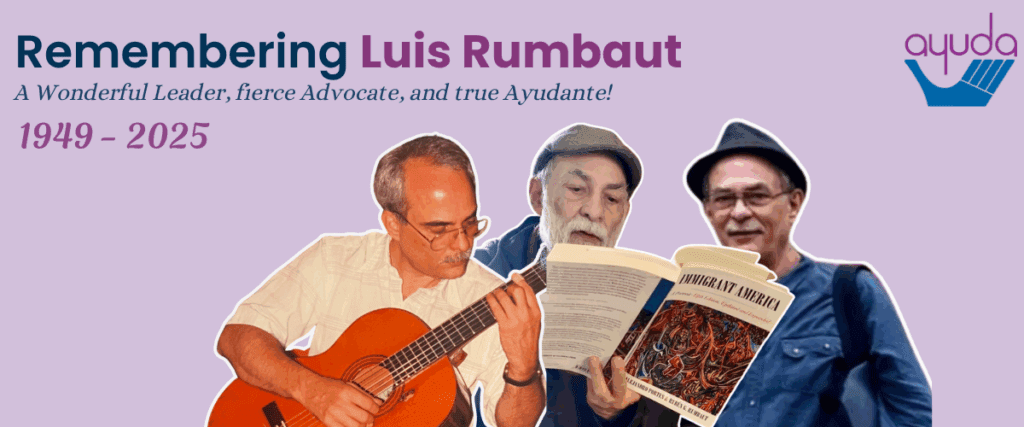
Ayuda stands today on the shoulders of visionaries who believed that immigrants deserve justice, dignity, and opportunity. Among those visionaries was Luis Eduardo Rumbaut, Ayuda’s second Executive Director, who passed away on June 28, 2025, at Washington Hospital Center. His passing invites us to reflect on the roots of Ayuda, the resilience of immigrant communities, and the remarkable life of a man who embodied justice, creativity, and service.
From Havana to Washington, D.C.
Luis’s story is woven into the broader immigrant experience that Ayuda exists to serve. He was born in Havana, Cuba, on October 27, 1949, and educated at the Colegio de Belén. At the age of 10, he immigrated to the United States with his parents and siblings, arriving with just $450 and cardboard suitcases. The family spoke no English, but brought with them a fierce determination to build a new life.
That determination carried Luis far. In 1966, he graduated from St. Pius X High School in Albuquerque, New Mexico, where he scored in the 99th percentile on the PSAT and was named a National Merit Scholar. He went on to earn a bachelor’s degree from Washington University in St. Louis, and later a J.D. from Antioch Law School in Washington, D.C. At every step, he excelled as a student and a leader, always combining brilliance with humility.
An Early Architect of Ayuda
Luis’s journey with Ayuda began while he was still a law student at Antioch. Drawn to the mission of providing legal, social, and language access services to low-income immigrants, he became one of the organization’s earliest leaders. From 1978 to 1980, as Ayuda’s second Executive Director, he helped shape the values and programs that remain at the core of our work today.
A historical account of Washington’s Latino/a/e community situates Luis within a broader movement:
“AYUDA LEGAL SERVICES was a legal aid center incorporated in 1973, although it stemmed from the 1960s George Washington University Law School clinic—Ayuda Para El Consumidor—that provided legal assistance to Spanish-speaking immigrants who had been targeted and victimized by consumer fraud. Rumbaut also worked at Ayuda, and by 1982, Yvonne Vega succeeded Moreno as the director of the organization. Today, the organization has a staff of over 60 across multiple offices in the metropolitan Washington area.”
Luis’s leadership during those early years gave Ayuda a firm foundation, ensuring that immigrant families could access justice at a time when such services were scarce. His influence is still felt in our advocacy, our legal programs, and our unwavering commitment to language access.
Public Service and Advocacy
After his tenure at Ayuda, Luis dedicated two decades to public service in the D.C. Office of Corporation Counsel (now the Office of the Attorney General). Rising from Senior Counsel to Director of the Civil Branch, Enforcement Division, he earned recognition for excellence in government service and was widely respected for his integrity and fairness.
Luis’s advocacy extended far beyond the courtroom. He was a voice for justice not only through law but also through culture, education, and public commentary. After retiring from government, he became Director of the Latin American Folk Institute, expanding appreciation for Latin music and heritage. And beginning in 2004, he single-handedly founded and edited the bilingual newsletter La Alborada, publishing five issues a week for more than a dozen years—a herculean effort that brought curated news and thoughtful editorial content on Latin America, with a particular focus on Cuba, to a wide international readership.
Musician, Writer, and Storyteller
To those who knew him personally, Luis was as much a musician and writer as he was a lawyer. From his arrival in Washington in 1972, he played the tres (Cuban guitar) and sometimes the cuatro (Puerto Rican guitar) in beloved neighborhood bands. With humor and flair, his ensembles bore names like Esto no tiene nombre (“This has no name”), Los Funcionarios (“The Bureaucrats”), and Los Olvidadizos (“The Forgetful Ones”).
In Adams Morgan and Columbia Heights, his music became part of the cultural fabric of D.C. Latin life. His artistry, like his advocacy, was rooted in joy, humor, and a deep love for his community and heritage.
A Legacy Continued Through Family
Luis’s legacy is carried on most profoundly by his family. His daughter, Jazmín Beatriz, serves as lead interpreter at the National Domestic Workers Alliance, continuing her father’s commitment to immigrant justice and language access. His son, Luis Ernesto, his five siblings, extended family, and countless friends will long cherish his memory.
He was recognized over the decades with awards for outstanding service to Spanish-speaking communities, but perhaps his greatest achievement was the love, humor, and humanity he shared with those around him.
Carrying Forward His Vision
At Ayuda, we honor Luis Eduardo Rumbaut not only by remembering his extraordinary life but also by carrying forward his vision. He believed that justice for immigrants was not just a cause, but a responsibility. His story reminds us that Ayuda’s mission is built on courage, creativity, and compassion, and that it is now our duty to continue the work he began.
In lieu of flowers, Luis’s family invites you to make a gift to Ayuda in his memory.
Your contribution will honor and affirm his legacy by supporting immigrant families with the legal, social, and language access services they need to build secure and thriving futures.